Friday, October 5, 2018

Getting ready to fly: Three important stages in flight

Image source: howstuffworks.com
Now, while NORAD isn’t just about airplanes, a number of personnel are devoted to making sure the jets are air-worthy for the protection of the United States and its allies. Probably, the most basic concept to know is the mechanics of flight. Here’s a quick refresher on the three most important stages in flight.


Towards the runway

The initial stage sees the jet being moved from its terminal to the runway. Normally, jets are pulled by a motorized vehicle, such as the ones found in commercial airport terminals. When the jet reaches the runway, it no longer needs the assistance of a tug to move.


Take off and climb

On the runway, pilots usually release the brakes to allow the jet to move forward on its own power. They push the throttle forward slowly to help the aircraft gain speed.


Looking at the take-off from a physics standpoint, airplanes are designed to have more air hit the bottom of the craft than the top – enough air to at first equal, then later on, overwhelm the gravitational pull of the Earth. This process is known as the production of “lift.”


Lift combine with thrust, allows the jet to not only move up, but forward as well. Adjusting the flaps on the wings allows for more lift.

Image source: explainthatstuff.com

Cruise

Airplanes normally reach a “cruising altitude” wherein the pilot reduces power until it matches that of the gravitational force. Through this, pilots maintain a level altitude in flight.


Scott Beale is an aerospace defense expert. He is the former CEO and president of Aerodynamics Incorporated and Flight works Inc. and most recently, the Senior Vice President of Corporate Sales and Development for Tempus Applied Solutions. Visit this blog to learn more about the aerospace defense industry.

Thursday, April 5, 2018

The Rise Of Norad

The North American Air Defense Command, or as NORAD was known in those days, was a brainchild of the Joint Canadian-U.S. Military Group in 1956. The recommendation was then approved by the U.S. Joint Chiefs of Staff in February the following year and formally announced in August. A month after the announcement, NORAD moved in their new command station, the Ent Air Force Base’s 1954 blockhouse.
Image source: norad.mil


In 1958, the U.S. and Canada agreed on a few things. First, the NORAD commander was to be a U.S. officer, with a Canadian vice-commander. The primary purpose of NORAD was established as an early warning and defense for SAC’s retaliatory forces. Later that year, Canada and the U.S. began the Continental Air Defense Integration North (CADIN). This would be for the Semi-Automatic Ground Environment air defense network. The entire command would need over $5 billion to remain operation yearly. This was justified by the Nike Zeus program and the development of Ballistic Missile Early Warning System sites.

The construction of the NORAD bunker at Canada’s CFB North Bay started in 1959 and completed in 1963. Along with this, the USAF had eight smaller combat control central systems that gave NORAD the capability to command the entire U.S. air defense.

Image source: Wikipedia.com


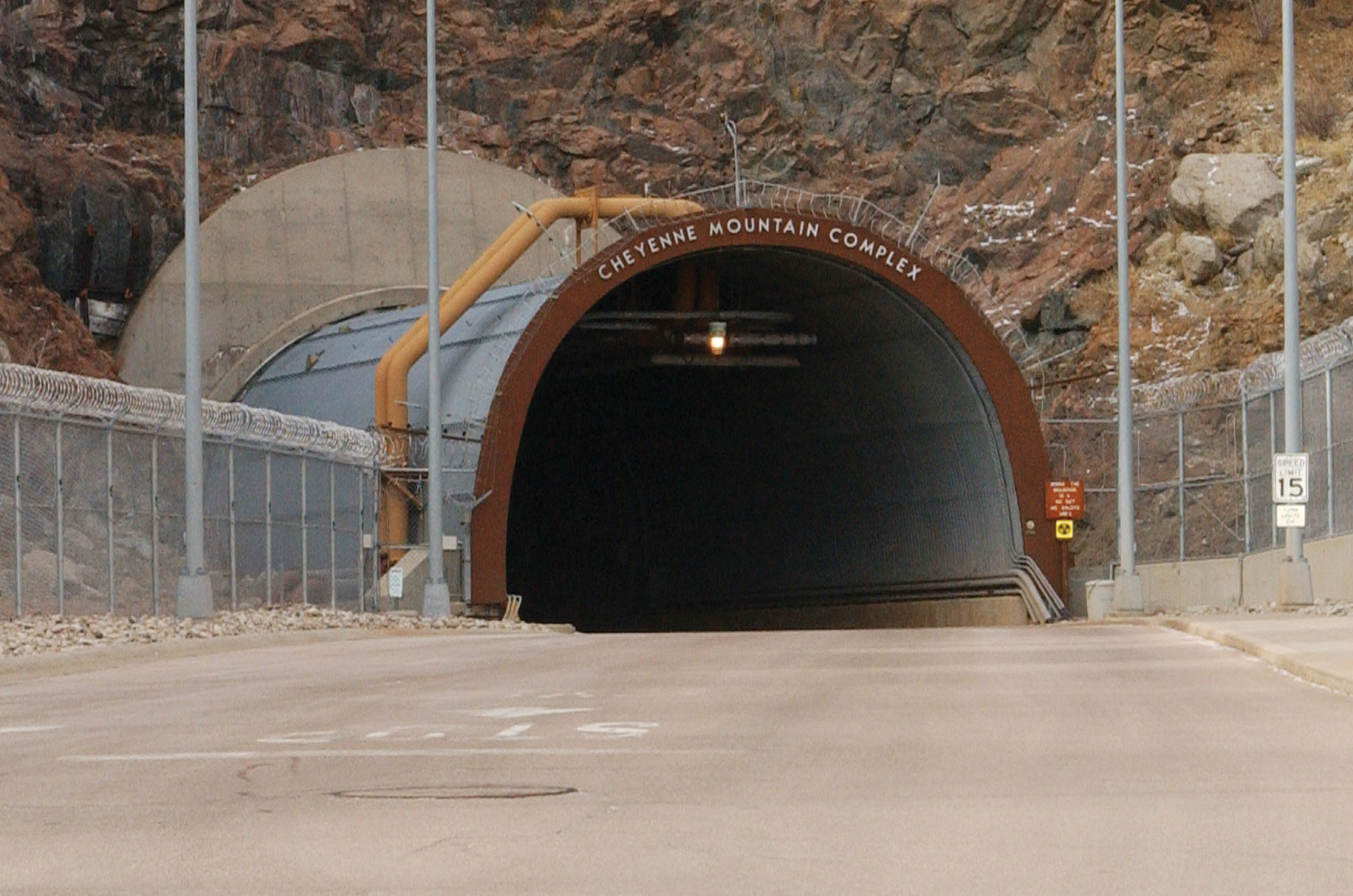
The Cheyenne Mountain nuclear bunker became the headquarters for the U.S. NORAD in 1960.
Aerospace defense expert Scott Beale was Senior Vice President of Sales and Corporate Development of Tempus Applied Solutions. For more articles on the aerospace defense industry, follow this blog.

Monday, April 2, 2018

The birth of Aerospace Defense in the United States

The precursor to the North American Aerospace Defense Command, or NORAD, was simply known as the Aerospace Defense Command. Though normally confused with one another, the Aerospace Defense Command was created to control the air defense forces during World War II.
               Image source: Wikipedia.org


During the war, the Continental United States air defense forces were under the Northeast, Northwest, Southeast, and Southwest Air Districts. These four air districts were created just before the Japanese attack on Pearl Harbor. Not only did these commands control USAAF air defense, but they also trained Army Ground Forces, in efforts to organize assignments and missions with air defenses.

A few months after the designation to the four air districts, the districts themselves were renamed to the 1st, 2nd, 3rd, and 4th Air Forces. The 1st and 4th Air Forces were subsequently assigned to manage civilian the Aircraft Warning Service on West and East Coasts of the country.

During this time, the government saw it prudent to have air defense warning, which the USAAF’s Aircraft Warning Corps (AWC) was tasked to provide. These warnings came through information centers via a network of Army Radar Stations all over the coasts.

                                                                    Image source: floridamemory.com


An integral part of Aerospace Defense, the AWC worked closely with Ground Observer Corps. AWC information centers are responsible for distributing information of imminent attack to the four Air Forces. The Air Forces would then scramble interceptor aircraft to defend the sovereign airspace of the U.S.

Scott Beale is an aerospace defense expert with over 20 years of leadership experience. He is the former CEO and president of Aerodynamics Incorporated and Flightworks Inc. and most recently, the Senior Vice President of Corporate Sales and Development for Tempus Applied Solutions. For more on the aerospace defense industry, click here.

Saturday, December 30, 2017

From dreams to reality: The flying car

Back in 2006, the tech and engineering company Terrafugia set the deadline for their flying car at 2019. Although many industry experts are skeptical about this given Terrafugia’s penchant for dropping their many projects, the flying car endeavor seems a little more possible than the rest. Why? Because the company has been bought by Chinese automotive giant, Geely. Geely also owns Volvo, and has acquired Terrafugia for an undisclosed amount. 

Source: youtube.com

But these are not the only entities aiming to produce the world’s first marketable flying car. The esteemed list includes Toyota, eVolo from Germany, and EHang from China. Early in 2017, the tech world was abuzz about Vahana unveiling and testing its first autonomous flying car. This, however, did not push through. 

There are a few challenges with creating a battery-powered flying car that can only fit as many as two passengers. The most prevalent challenge is making a profit. 

 Now, while many companies and people have amazing ideas and designs for the flying car of tomorrow, funding will always be an issue. Investors will only invest if they see huge returns. The upside, though, is that some people such as Google’s Larry Page, a billionaire himself, has made it his personal project to see that a car flies. 

The same thing with Terrafugia – with the acquisition, Geely’s funding may make all the difference and create reality from this dream.

Source: inhabitat.com

Scott Beale is a graduate of the Ohio State University, where he majored in Aviation Business Management. The licensed commercial fixed wing and rotor wing pilot with Jet Type ratings in the Gulf stream and Citation aircraft is currently the Senior Vice President of Sales and Corporate Development of Tempus Applied Solutions. Learn more about aviation here.

Tuesday, November 14, 2017

A Brief History Of Aeromedical Evacuation

Aeromedical evacuation has been used in the military for a century now. In fact, the first recorded event wherein an aircraft was used to move wounded personnel was 100 years ag0 – in 1917, in the Sinai Peninsula. A Royal Aircraft Factory B.E.2c arrived 30 miles south of El Arish and flew out a wounded soldier from the Imperial Camel Corps. The soldier had been shot in the ankle during the Bir el Hassana raid. People right then and there knew the value of aeromedical evacuation since the travel time to bring the soldier to safety was only 45 minutes. The same trip on land would have been about three days, with considerable more effort.

Image source: Wikipedia.com

The following decade saw the beginnings of a mass practice in aeromedical evacuation as a number of services opened worldwide. With aircraft technology still being experimented on, however, the services were flawed, and not always successful.

France and the U.K. continued to work on aeromedical evacuation, proving its efficiency in Somaliland in the 1920s. The Airco DH.9A was modified as an air ambulance, and in that span, the French were able to evacuate over 7,000 personnel. It continued on until the Spanish Civil War when air ambulances became the mode of choice for wounded soldiers.

Image source: health.mil

Scott Beale is a huge part of Tempus Applied Solutions’s success in the aviation industry. To read more about him and Tempus, check out this blog.